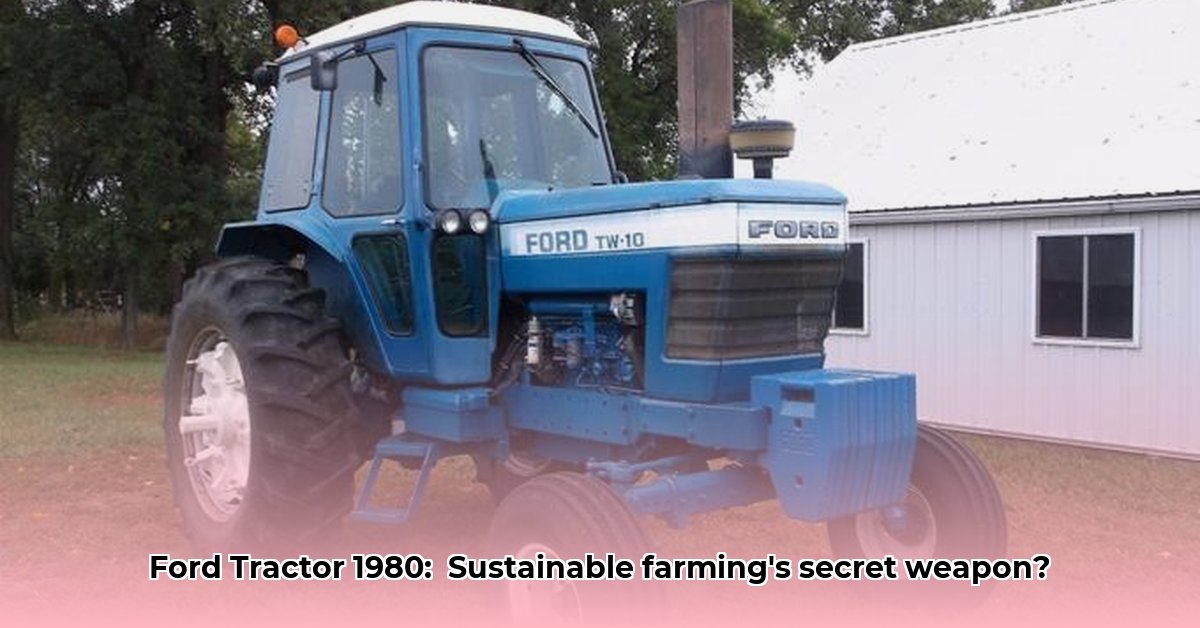
A Piece of Farming History and its Unexpected Impact on Sustainability
The year is 1980. Gas prices soar, and across the American heartland, a familiar sight dominates the landscape: the Ford tractor, a workhorse of the fields. But beyond its sheer power and reliability, did this iconic machine contribute to sustainable farming practices? For more on classic Ford tractors, check out this site. The story, as it turns out, is both complex and revealing.
It's easy to romanticize the past, imagining a simpler time when farming was inherently sustainable. However, the reality is far more nuanced. The 1980 Ford tractor, like many technological advancements, presented both opportunities and challenges for sustainable agriculture. While the tractor significantly boosted efficiency – imagine, one farmer using a team of horses needing a full day to plow an acre, compared to the same farmer plowing ten times that acreage with a Ford tractor in the same timeframe – this efficiency came at a cost. Early tractors were notorious gas-guzzlers, emitting significant greenhouse gasses and relying heavily on finite fossil fuel resources. How did this trade-off impact the future of sustainable agriculture? That’s a key question we'll explore.
The Double-Edged Plow: Mechanization's Impact
The dramatic increase in agricultural productivity fueled by mechanization, including the Ford tractor, was undeniably transformative. More food was produced to feed a growing global population. But this efficiency increase came with its own set of problems. These early tractors, while powerful, were also incredibly fuel-intensive, consuming vast quantities of fossil fuels and releasing substantial greenhouse gas emissions into the atmosphere. This raises a crucial point: Did the increased food production outweigh the environmental consequences? The answer, unfortunately, isn't straightforward.
Small Steps, Big Changes: Technological Advancements
Despite not being initially designed with sustainability in mind, the 1980 Ford tractor represented a significant technological leap forward compared to its predecessors. Engineers continuously improved engine design, boosting overall durability. This led to fewer breakdowns, translating into less wasted time and, importantly, less fuel consumption. These seemingly small incremental improvements, each refinement enhancing the engine's performance, had a significant cumulative effect on the efficiency of farming operations. It was a gradual process, but every small enhancement helped to shift the industry, however slowly, towards more sustainable practices. Consider this: How much fuel was conserved overall due to improved engine efficiency over the lifetime of a typical Ford 1980 tractor? Further research is required to quantify this impact.
The Shifting Fields: Industry Consolidation and its Effects
Ford’s decision in 1990 to sell its farm equipment division to Fiat significantly altered the agricultural landscape. This consolidation resulted in larger, more powerful corporations with streamlined production processes. While this led to economies of scale—lowering costs and potentially boosting efficiency—it also raised concerns about reduced competition and a potential slowdown in the development of environmentally friendlier technologies. This shift in the industry structure had long-term implications for the trajectory of sustainable agricultural practices.
The Legacy: Weighing the Pros and Cons
To understand the 1980 Ford tractor's impact, let's examine its positive and negative contributions to sustainability:
| Aspect | Positive Impacts | Negative Impacts |
|---|---|---|
| Mechanization | Increased food production, reduced labor needs, improved efficiency | High fuel consumption, increased greenhouse gas emissions, fossil fuel dependence |
| Technological Advancements | Enhanced fuel efficiency (relative to earlier models), greater durability, reduced downtime | Continued reliance on fossil fuels, potential for resource depletion |
| Industry Consolidation | Streamlined production, potential cost efficiencies | Reduced competition, slower innovation, potential negative impact for small farmers |
How to Assess the Environmental Impact of Ford Tractors on Sustainable Farming Practices
Key Takeaways:
- The 1980 Ford tractor, while a product of its time, indirectly contributed to the evolution of farming, influencing some aspects of modern sustainability.
- Evaluating its environmental impact requires analyzing fuel efficiency, durability affecting replacement frequency, and farming techniques used alongside it.
- Direct comparisons with modern tractors are essential for understanding fuel efficiency and technological advancements.
- A full lifecycle assessment, encompassing manufacturing, operation, and disposal, offers the most complete evaluation.
The 1980s witnessed a rapid transformation in agriculture, and the Ford tractor was at the forefront. Yet determining its impact on sustainable farming practices remains a challenge. How can we accurately gauge its environmental impact? What specific metrics should we use? Examining fuel efficiency, durability, and the farming practices employed alongside the tractor are critical.
Fuel Efficiency and its Impact
Diesel engines, prevalent in 1980 Ford tractors, while more efficient than gasoline counterparts at the time, still produced substantial greenhouse gas emissions. How do the fuel efficiency metrics of the 1980 Ford tractor compare to those of other tractors from the same era? Gathering and analyzing this historical data would be essential for a complete assessment.
Durability and Longevity: A Double-Edged Sword
The robust construction of these Ford tractors led to longer lifespans, reducing the need for frequent replacements, thereby minimizing environmental impact from manufacturing new machines. However, this longevity also meant that older, less efficient models remained in use for extended periods, potentially offsetting the initial benefits.
Tillage Practices and Soil Health
The 1980 Ford tractor, while a neutral tool itself, enabled the widespread use of conventional tillage practices. This type of intense soil disturbance can lead to erosion and reduced carbon sequestration in the soil. This highlights a critical point: the tractor itself isn't solely responsible for the environmental impact; the farming practices employed in conjunction with the technology are equally important.
Comparing Then and Now
In order to fully understand the environmental impact of these tractors, we must compare them to modern counterparts. Today's tractors offer significant advancements in fuel efficiency and reduced emissions. They also often incorporate features promoting sustainability, such as GPS technology for precise fertilizer and pesticide applications.
The Lifecycle Approach: From Cradle to Grave
To gain a complete understanding, we must adopt a lifecycle approach, considering the entire journey of a 1980 Ford tractor: manufacturing, operation, and disposal. Each stage contributes to its overall environmental footprint.
The Missing Pieces
The lack of extensive data on fuel efficiency and emissions from 1980 Ford tractors presents a major obstacle to a comprehensive assessment. More research is urgently needed to locate and analyze this historical information.